

FREELANCE · FOODOGEKI
UX for a real-time multiplayer game
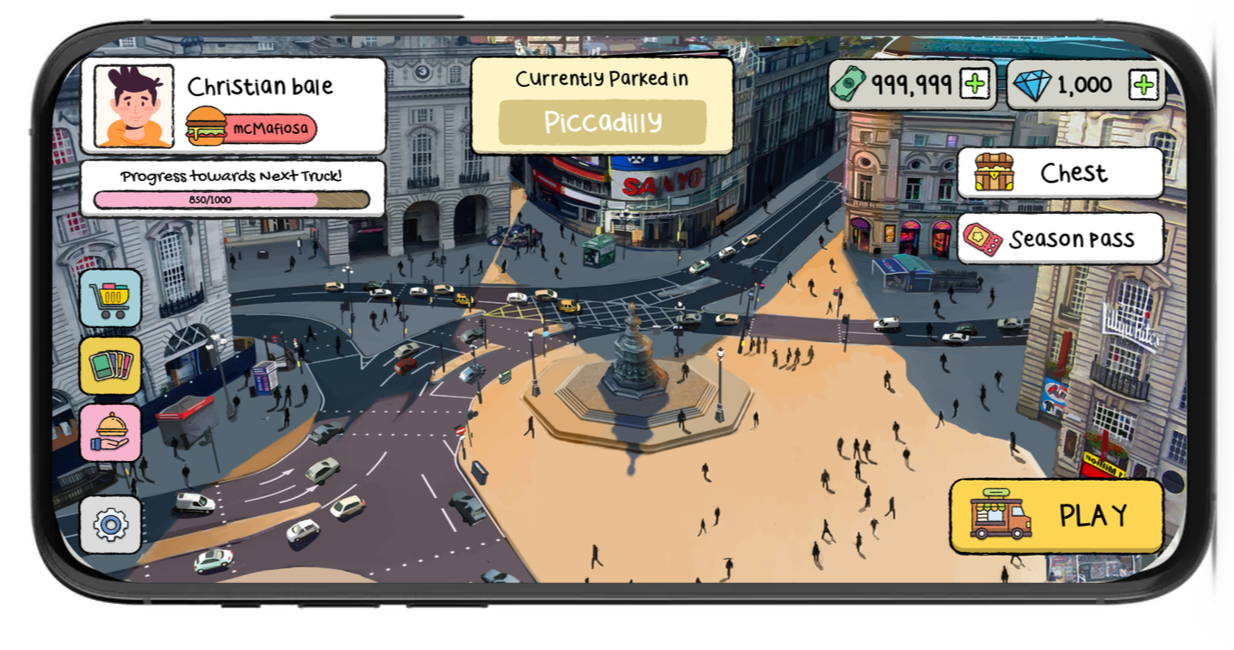
Foodogeki is a mobile game where food trucks and chefs compete to sell food to customers in real time. I designed the user flow and interface layout for every part of the game - deciding where, when, and how each feature should appear so players could stay focused on gameplay.
ROLE
UX Designer
TIMELINE
Nov 2022 - Jan 2024
TEAM
UX Designer, Software Engineers
TOOLS
Figma, Miro
01
The context
Foodogeki takes the competitive, fast-paced world of the food truck industry and turns it into an accessible mobile game - players run food trucks and battle other chefs in real time to sell to customers, with realistic business mechanics woven into the gameplay.
My job was to design the user flow and interface layout for every part of the game: deciding where and when specific features should appear, and how to structure the main screens so players stayed focused on gameplay and their goals rather than fighting the interface.
02
How I got there
Game design was new territory for me, so I researched broadly: competitive analyses of direct and indirect competitors, general research on gaming users, and game design mechanisms that support good player experience. Combined with the client's business goals, this became the basis for a set of user personas.
Using the personas and research on gameplay mechanics, I put together the first drafts of the information architecture and user flows - prioritizing an experience players could pick up with as few distractions as possible, while still feeling immersed in the game's world.
Once the flow direction was set, I moved into wireframing and prototyping so the design could be tested in an app format. Since I was responsible for UX rather than UI on this project, I handed the wireframes to a trusted UI designer, who turned them into the mockups used in testing.
The mockups went through rounds of testing and iteration to refine the flow before moving further into development.
03
Key decisions
Owning UX, deliberately handing off UI
I scoped my role to user flow and interface layout, and handed wireframes to a dedicated UI designer for visual execution rather than trying to own both. It meant giving up control over the final look, but it meant the visual design got a specialist's attention while I focused on making sure the underlying flow actually worked for players.
Designing for repetition, not just first use
Because Foodogeki is a game players return to again and again, I designed flows around making core loops fast and easy to repeat, rather than optimizing only for a strong first impression. Features had to integrate seamlessly into that loop — as an expected, welcome step, not an interruption.
04
Outcome
Foodogeki ran as an active project through August 2024, where the research, flows, and iterative testing process shaped a complete game structure. While the project is no longer active, it remained a strong example of designing UX for a genuinely new format for me - repeat-play gameplay rather than a one-time task flow.
05
Reflection
Game design was a new area for me, and it shifted how I think about UX. Most of my previous work centered on making a functional process feel enjoyable - this project flipped that, asking me to make a process fun and easy first. I learned a lot about designing for repetition: how to make a flow someone will want to return to, and how to fold features into that loop so they feel like an expected part of the experience rather than a distraction from it.